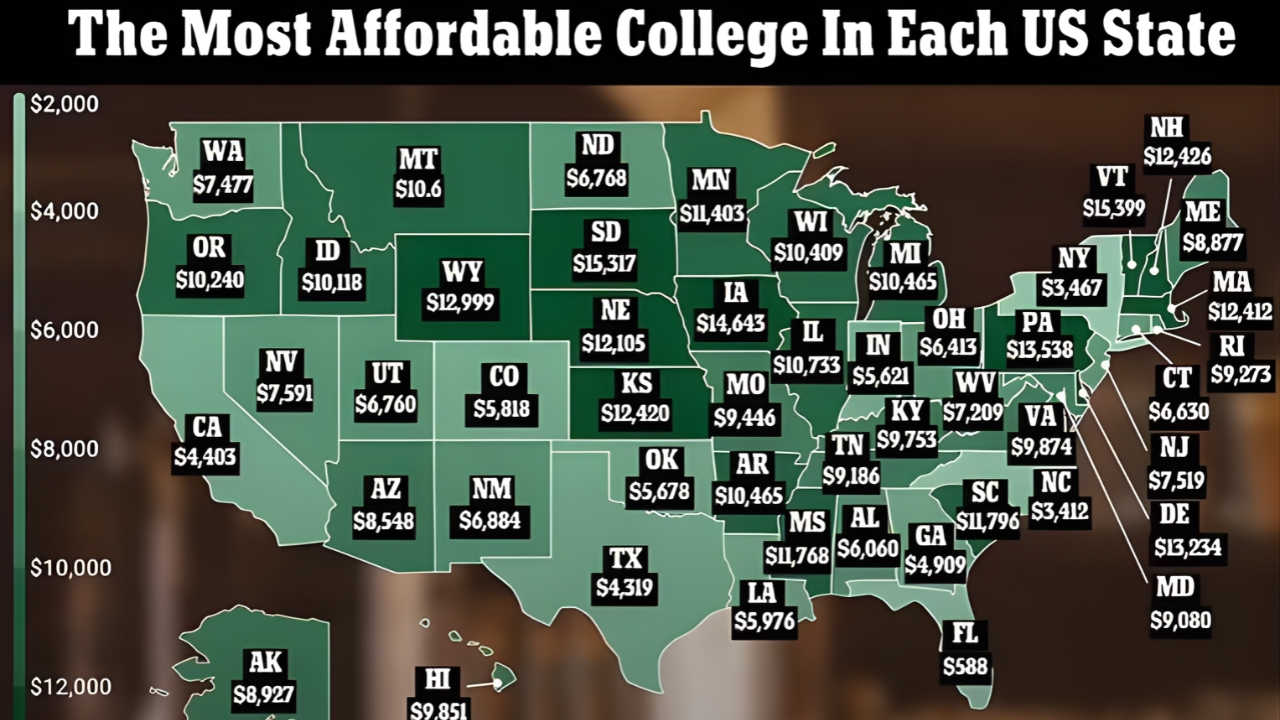
The dream of obtaining a higher education degree in the United States often comes with a daunting financial reality. As we move through 2025, the disparity in tuition fees across state lines has become more pronounced than ever. For many families, the cost of college is no longer just a flat fee but a complex calculation involving residency, state subsidies, and local economic conditions. While some students in the South and West enjoy relatively manageable tuition rates, their peers in the Northeast often face “sticker prices” that are nearly double. This geographical divide highlights a shifting landscape where where you live matters just as much as what you study.
The Regional Giants of Higher Education Expenses
When examining the most expensive regions for higher education, the Northeast consistently sits at the top of the list.3 States like Vermont, New Hampshire, and Connecticut have long been associated with high-cost public and private institutions.4 In Vermont, for instance, the average in-state tuition for public four-year universities has pushed beyond the $18,000 mark.5 These high costs are often the result of limited state-level funding for public universities, shifting the financial burden onto the students.6 Furthermore, the presence of prestigious, long-standing institutions in these areas tends to drive up the overall market rate for education in the surrounding region.
Affordability Havens in the South and West
On the opposite end of the spectrum, states like Florida and Wyoming continue to lead the nation in affordability.7 Florida, in particular, has maintained a robust system of low-cost tuition for its residents, with average annual fees often falling below $7,000.8 This is largely due to aggressive state legislative efforts to freeze tuition and provide significant subsidies to public universities. Similarly, Wyoming and Utah benefit from strong state-level support and lower costs of living, making higher education accessible to a broader demographic.9 These states prove that state-funded initiatives can successfully keep the “ivory tower” within reach for middle-class and low-income families.
Comparison of College Costs by State (2024–2025)
The table below highlights the stark contrast between the most and least expensive states for in-state tuition at public four-year institutions.
| State | Average In-State Tuition | Cost Status |
| Vermont | $18,090 | Most Expensive |
| New Hampshire | $18,000 | High Cost |
| Pennsylvania | $16,330 | High Cost |
| New Jersey | $17,050 | High Cost |
| National Average | $11,610 | Baseline |
| Montana | $8,250 | Low Cost |
| Utah | $8,000 | Affordable |
| North Carolina | $7,470 | Affordable |
| Wyoming | $7,430 | Very Affordable |
| Florida | $6,360 | Least Expensive |
The Financial Impact of Residency Status
One of the most critical factors in determining college costs is residency.10 The gap between in-state and out-of-state tuition remains one of the largest hurdles for students looking to move across state lines. On average, an out-of-state student pays nearly three times the amount of a local resident. This pricing structure exists because public universities are primarily funded by state taxpayers. To mitigate these high costs, many students look toward regional reciprocity agreements, such as the Western Undergraduate Exchange (WUE), which allows students to attend participating out-of-state schools at a significantly reduced rate.11
Income vs. Cost: The True Affordability Metric
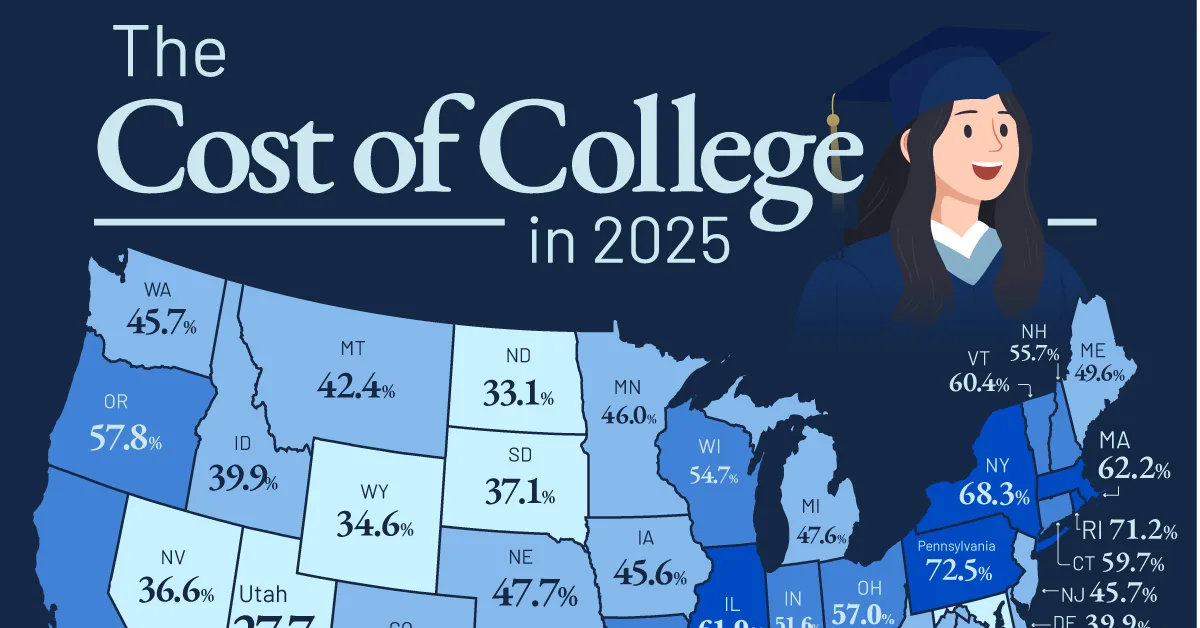
True affordability isn’t just about the dollar amount on the bill; it’s about that cost relative to what a family earns. According to recent data visualizations, Pennsylvania ranks as one of the most burdensome states when comparing college costs to median household income.12 In such states, the “cost of attendance” can swallow more than 70% of a family’s annual earnings. Conversely, in Utah, that figure drops to under 28%.13 This comparison sheds light on the growing “affordability gap,” where even mid-range tuition can feel impossible in areas where wages haven’t kept pace with the rising costs of housing and education.
Trends Shaping the Future of Tuition in 2026
Looking ahead to the 2026 academic year, early projections suggest that tuition will continue to rise at an annual rate of approximately 2% to 4%.14 While this is a modest increase compared to historical spikes, the compounding nature of these raises means that a degree continues to grow more expensive in real terms. We are also seeing a shift toward “net price” transparency, where schools are being pushed to show the final cost after grants and scholarships are applied. For many students, the actual out-of-pocket expense is significantly lower than the advertised sticker price, though navigating the financial aid system remains a barrier for many.15
Strategic Planning for Prospective Students
Navigating these costs requires a proactive approach. Students are increasingly looking at community colleges as a way to complete their general education requirements at a fraction of the cost before transferring to a four-year institution. Additionally, the rise of online degree programs has created a “borderless” education market where students can sometimes access lower rates regardless of where they physically reside. As we move further into 2025, the key to managing college debt lies in understanding these regional variations and leveraging every available state subsidy and reciprocity program.
Big Day: Gas Prices Are Finally Falling, But How Much Will You Save?

Frequently Asked Questions
Which state has the cheapest college tuition?
Currently, Florida holds the title for the lowest average in-state tuition for public four-year institutions, followed closely by Wyoming and North Carolina.16
Why is out-of-state tuition so much higher?
Public universities are subsidized by state taxes.17 Out-of-state students do not pay into these state taxes, so they are charged a higher rate to cover the full cost of their education.
What is a tuition reciprocity agreement?
It is an arrangement between states that allows students to attend out-of-state public colleges at a discounted rate, often making it nearly as affordable as in-state tuition.19
Disclaimer
The content is intended for informational purposes only. you can check the officially sources our aim is to provide accurate information to all users.
New Gas Prices by U.S. State in 2025: Updated Map Shows What Drivers Pay Now